---
title: 4622(S) A security package has been loaded by the Local Security Authority. (Windows 10)
description: Describes security event 4622(S) A security package has been loaded by the Local Security Authority.
ms.pagetype: security
ms.prod: w10
ms.mktglfcycl: deploy
ms.sitesec: library
ms.localizationpriority: none
author: dansimp
ms.date: 04/19/2017
ms.reviewer:
manager: dansimp
ms.author: dansimp
---
# 4622(S): A security package has been loaded by the Local Security Authority.
**Applies to**
- Windows 10
- Windows Server 2016
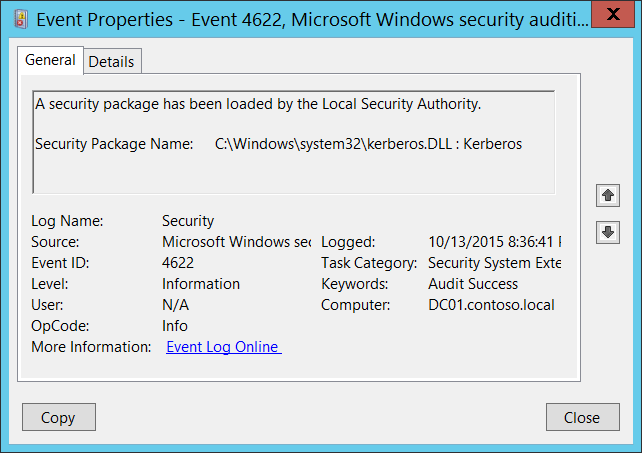 ***Subcategory:*** [Audit Security System Extension](audit-security-system-extension.md)
***Event Description:***
This event generates every time [Security Package](https://msdn.microsoft.com/library/windows/desktop/aa380501(v=vs.85).aspx) has been loaded by the Local Security Authority ([LSA](https://msdn.microsoft.com/library/windows/desktop/aa378326(v=vs.85).aspx)).
Security Package is the software implementation of a security protocol (Kerberos, NTLM, for example). Security packages are contained in security support provider DLLs or security support provider/authentication package DLLs.
Each time the system starts, the LSA loads the Security Package DLLs from **HKEY\_LOCAL\_MACHINE\\SYSTEM\\CurrentControlSet\\Control\\Lsa\\OSConfig\\Security Packages** registry value and performs the initialization sequence for every package located in these DLLs.
It is also possible to add security package dynamically using [AddSecurityPackage](https://msdn.microsoft.com/library/windows/desktop/dd401506(v=vs.85).aspx) function, not only during system startup process.
> **Note** For recommendations, see [Security Monitoring Recommendations](#security-monitoring-recommendations) for this event.
***Subcategory:*** [Audit Security System Extension](audit-security-system-extension.md)
***Event Description:***
This event generates every time [Security Package](https://msdn.microsoft.com/library/windows/desktop/aa380501(v=vs.85).aspx) has been loaded by the Local Security Authority ([LSA](https://msdn.microsoft.com/library/windows/desktop/aa378326(v=vs.85).aspx)).
Security Package is the software implementation of a security protocol (Kerberos, NTLM, for example). Security packages are contained in security support provider DLLs or security support provider/authentication package DLLs.
Each time the system starts, the LSA loads the Security Package DLLs from **HKEY\_LOCAL\_MACHINE\\SYSTEM\\CurrentControlSet\\Control\\Lsa\\OSConfig\\Security Packages** registry value and performs the initialization sequence for every package located in these DLLs.
It is also possible to add security package dynamically using [AddSecurityPackage](https://msdn.microsoft.com/library/windows/desktop/dd401506(v=vs.85).aspx) function, not only during system startup process.
> **Note** For recommendations, see [Security Monitoring Recommendations](#security-monitoring-recommendations) for this event.
***Event XML:***
```
-
-
4622
0
0
12289
0
0x8020000000000000
1048131
Security
DC01.contoso.local
-
C:\\Windows\\system32\\kerberos.DLL : Kerberos
```
***Required Server Roles:*** None.
***Minimum OS Version:*** Windows Server 2008, Windows Vista.
***Event Versions:*** 0.
***Field Descriptions:***
**Security Package Name** \[Type = UnicodeString\]**:** the name of loaded Security Package. The format is: DLL\_PATH\_AND\_NAME: SECURITY\_PACKAGE\_NAME.
These are some Security Package DLLs loaded by default in Windows 10:
- C:\\Windows\\system32\\schannel.DLL : Microsoft Unified Security Protocol Provider
- C:\\Windows\\system32\\schannel.DLL : Schannel
- C:\\Windows\\system32\\cloudAP.DLL : CloudAP
- C:\\Windows\\system32\\wdigest.DLL : WDigest
- C:\\Windows\\system32\\pku2u.DLL : pku2u
- C:\\Windows\\system32\\tspkg.DLL : TSSSP
- C:\\Windows\\system32\\msv1\_0.DLL : NTLM
- C:\\Windows\\system32\\kerberos.DLL : Kerberos
- C:\\Windows\\system32\\negoexts.DLL : NegoExtender
- C:\\Windows\\system32\\lsasrv.dll : Negotiate
## Security Monitoring Recommendations
For 4622(S): A security package has been loaded by the Local Security Authority.
- Typically this event has an informational purpose. If you defined the list of allowed Security Packages in the system, then you can check is “**Security Package Name”** field value in the whitelist or not.