---
title: 5633(S, F) A request was made to authenticate to a wired network. (Windows 10)
description: Describes security event 5633(S, F) A request was made to authenticate to a wired network.
ms.pagetype: security
ms.prod: w10
ms.mktglfcycl: deploy
ms.sitesec: library
ms.localizationpriority: none
author: dansimp
ms.date: 04/19/2017
ms.reviewer:
manager: dansimp
ms.author: dansimp
---
# 5633(S, F): A request was made to authenticate to a wired network.
**Applies to**
- Windows 10
- Windows Server 2016
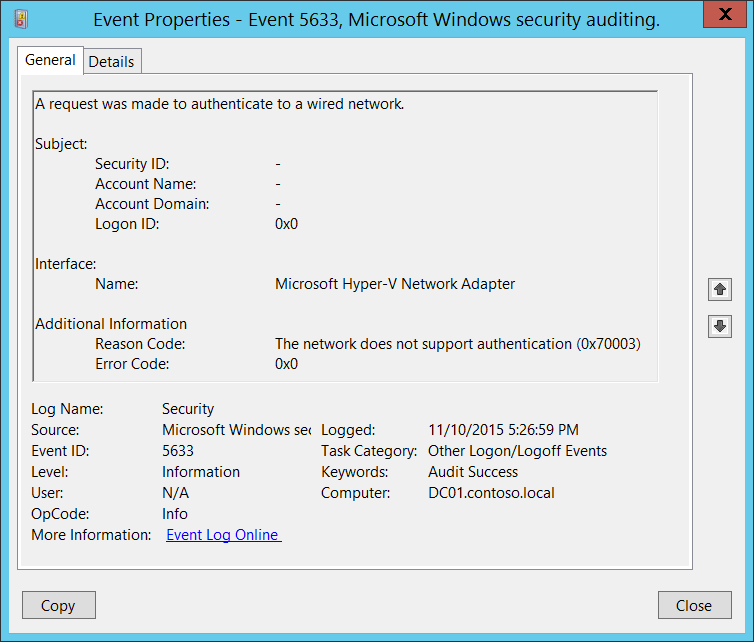 ***Subcategory:*** [Audit Other Logon/Logoff Events](audit-other-logonlogoff-events.md)
***Event Description:***
This event generates when [802.1x](https://technet.microsoft.com/library/hh831831.aspx) authentication attempt was made for wired network.
It typically generates when network adapter connects to new wired network.
> **Note** For recommendations, see [Security Monitoring Recommendations](#security-monitoring-recommendations) for this event.
***Subcategory:*** [Audit Other Logon/Logoff Events](audit-other-logonlogoff-events.md)
***Event Description:***
This event generates when [802.1x](https://technet.microsoft.com/library/hh831831.aspx) authentication attempt was made for wired network.
It typically generates when network adapter connects to new wired network.
> **Note** For recommendations, see [Security Monitoring Recommendations](#security-monitoring-recommendations) for this event.
***Event XML:***
```
-
-
5633
0
0
12551
0
0x8020000000000000
1198715
Security
DC01.contoso.local
-
Microsoft Hyper-V Network Adapter
-
-
-
0x0
0x70003
The network does not support authentication
0x0
```
***Required Server Roles:*** None.
***Minimum OS Version:*** Windows Server 2008, Windows Vista.
***Event Versions:*** 0.
***Field Descriptions:***
**Subject:**
- **Security ID** \[Type = UnicodeString\]**:** User Principal Name (UPN) of account for which 802.1x authentication request was made.
> **Note** [User principal name](https://msdn.microsoft.com/library/windows/desktop/aa380525(v=vs.85).aspx) (UPN) format is used to specify an Internet-style name, such as UserName@Example.Microsoft.com.
- **Account Name** \[Type = UnicodeString\]**:** the name of the account for which 802.1x authentication request was made.
- **Account Domain** \[Type = UnicodeString\]**:** subject’s domain or computer name. Formats vary, and include the following:
- Domain NETBIOS name example: CONTOSO
- Lowercase full domain name: contoso.local
- Uppercase full domain name: CONTOSO.LOCAL
- For some [well-known security principals](https://support.microsoft.com/kb/243330), such as LOCAL SERVICE or ANONYMOUS LOGON, the value of this field is “NT AUTHORITY”.
- For local user accounts, this field will contain the name of the computer or device that this account belongs to, for example: “Win81”.
- **Logon ID** \[Type = HexInt64\]**:** hexadecimal value that can help you correlate this event with recent events that might contain the same Logon ID, for example, “[4624](event-4624.md): An account was successfully logged on.”
**Interface:**
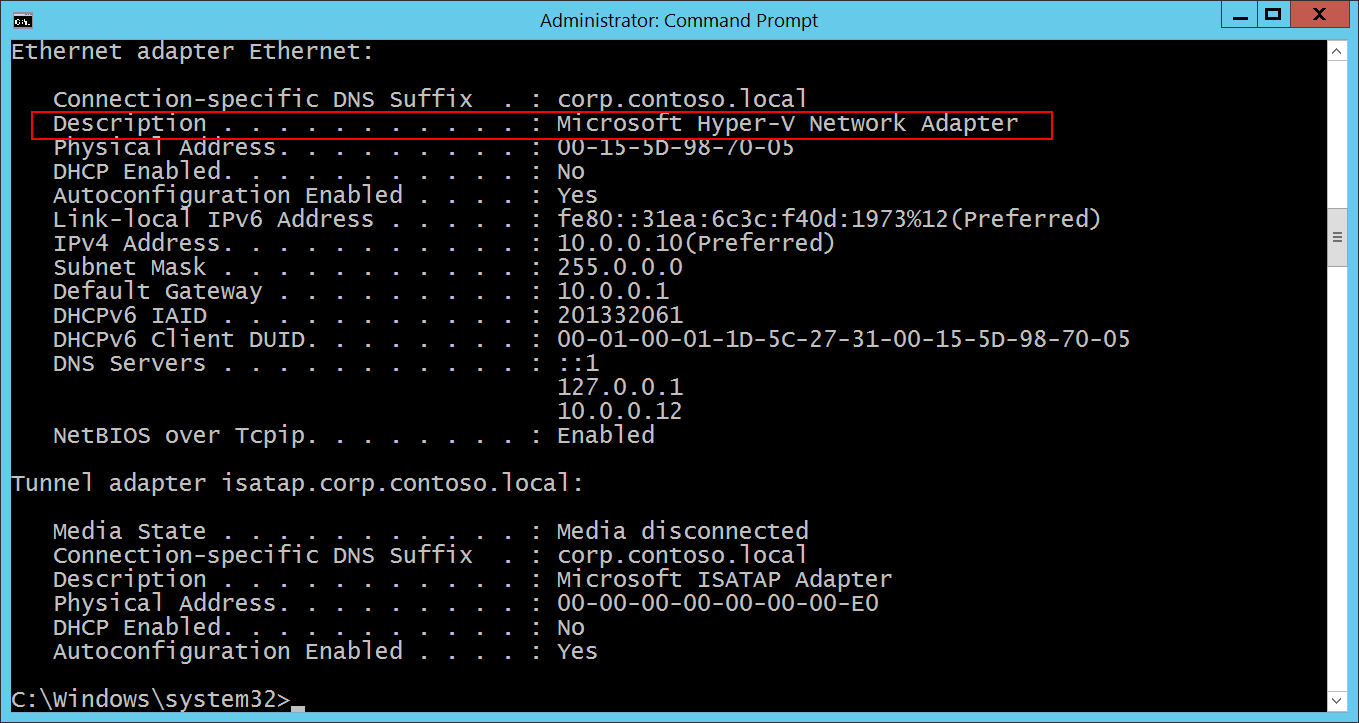
- **Name** \[Type = UnicodeString\]: the name (description) of network interface which was used for authentication request. You can get the list of all available network adapters using “**ipconfig /all**” command. See “Description” row for every network adapter:
 **Additional Information:**
- **Reason Code** \[Type = UnicodeString\]: contains Reason Text (explanation of Reason Code) and Reason Code for wired authentication results. See more information about reason codes for wired authentication here: , .
- **Error Code** \[Type = HexInt32\]: unique [EAP error code](https://msdn.microsoft.com/library/windows/desktop/aa813691(v=vs.85).aspx).
## Security Monitoring Recommendations
For 5633(S, F): A request was made to authenticate to a wired network.
- There is no recommendation for this event in this document.
**Additional Information:**
- **Reason Code** \[Type = UnicodeString\]: contains Reason Text (explanation of Reason Code) and Reason Code for wired authentication results. See more information about reason codes for wired authentication here: , .
- **Error Code** \[Type = HexInt32\]: unique [EAP error code](https://msdn.microsoft.com/library/windows/desktop/aa813691(v=vs.85).aspx).
## Security Monitoring Recommendations
For 5633(S, F): A request was made to authenticate to a wired network.
- There is no recommendation for this event in this document.